How it works
From your till to your bank, without the queue
The whole service is four steps and one monthly statement. Here is what each one actually involves, and what we need from you.
We install
A surveyor checks power, network, flooring and delivery access, then recommends a machine sized to your takings. Installation and staff training is typically a single morning.
You deposit
Staff feed notes in at the point they would otherwise skim the till. Every note is validated and counted; every deposit is time-stamped against the member of staff who made it.
We collect
An insured national cash-in-transit partner empties the safe on your schedule — and the safe requests its own collection when it reaches around 60–70% of capacity, so a busy week does not leave you full. Nobody on your payroll walks anywhere with a deposit bag again.
You're credited
Funds are credited with same-day value* and reach your bank by midday the next working day, and the deposit, the rate applied and the running total appear in your portal.
The hardware
What is actually in the box
Notes go in at the top and never come back out. Everything below the feeder is sealed, and nobody on your payroll has a key to it.
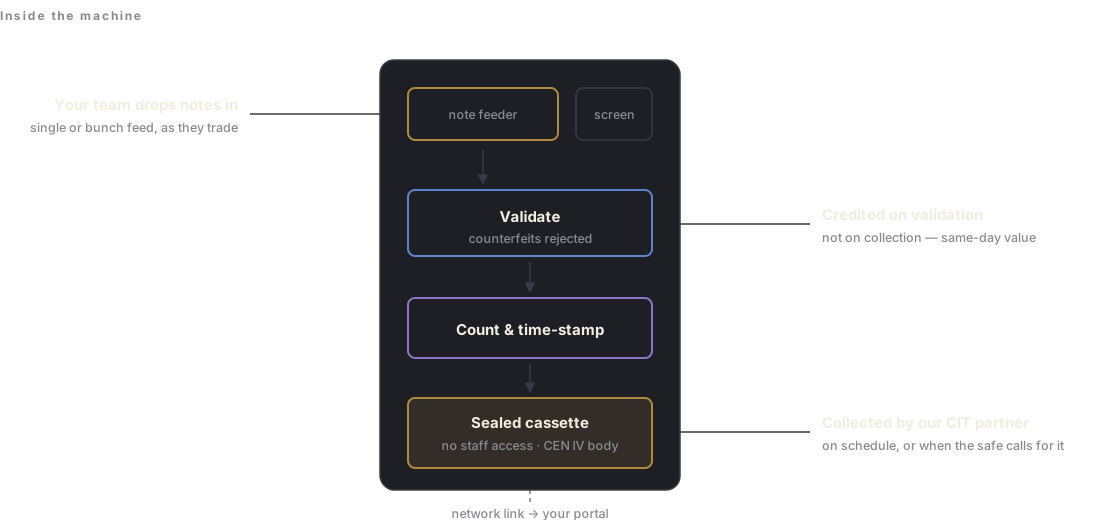
The hardware
The right machine, not the one we happen to stock
We are not tied to a single manufacturer. We specify from several ranges, and the right machine is the smallest one that comfortably absorbs your busiest week — decided at the survey, not before it. Make and model are confirmed on your quote.
| Option | Note capacity | Deposit speed | Best for |
|---|---|---|---|
| Option A Compact deposit safe |
1,500 notes freefall bag; additional safe capacity optional |
20 notes/min single or bunch feed |
Small to midsize retailers wanting quick, secure deposit in a small footprint |
| Option B Mid-volume validator · CEN IV |
2,500 notes 10,000 with the high-volume canvas bag |
150 notes/min 100-note feeder |
Medium-volume retailers where security and process both matter |
| Option C High-volume validator · CEN IV |
10,000 notes 15,000 with the high-volume canvas bag |
300 notes/min 250-note feeder |
Busy cash environments: larger retail, hospitality, bookmakers, supermarkets. Optional integrated coin module |
| Option D Recyclers, coin and multi-site |
Higher capacities available | Varies | Sites above the volumes above, sites giving change back over the counter, heavy coin, or a group wanting one reporting view across many branches |
Options B and C use Bank of England certified high-speed note sorters and carry CEN IV rated safe bodies as standard, with UL options; Option A uses a UL-type 12mm body. Exact model, capacity option and rental are confirmed on your quote after the site survey.
What we need from you
The survey checklist
Have these to hand and an assessment takes about twenty minutes.
Your numbers
Weekly or annual takings, roughly what your bank charges you to deposit cash, how many staff hours a week go on counting and banking, and any current smart safe or CIT contract with its expiry date.
Your site
Ground floor space with power and network, a solid floor, and delivery access. We check alarm and CCTV arrangements too — they affect insurance, not eligibility.
Questions
The things people ask first
How long does installation take?
A site survey first — we check power, network, floor and access. Installation itself is typically a morning, including training your team. Most sites are depositing the same day.
Who is responsible for the money once it is in the safe?
Not you. It is still your money, but from the moment a note is validated and accepted by the machine it is covered under our providers' insurance, up to the limit set out in your agreement — not under your business policy, and not down to your staff. You do not deal with the insurer or chase the haulier either: we appoint and manage the cash-in-transit operator, so you have one contract and one company to call.
What happens if the safe rejects a note?
It is returned immediately for the member of staff to inspect. A rejected note is almost always a genuine note in poor condition — but occasionally it is a counterfeit you would otherwise have banked and lost, with no recourse.
How often do you collect?
On a schedule set by your volumes — anywhere from daily to fortnightly — and on demand. When the safe reaches around 60–70% of its capacity it notifies the provider automatically and a collection is arranged, at no extra charge, so an unexpectedly busy week does not leave you with a full machine. Your agreement sets a maximum you can hold in the safe; the only time collections are charged for separately is where a site is consistently running above it, and then we would normally resize the machine or the schedule instead. Because you are credited on validation rather than on collection, the schedule affects logistics, not your working capital.
Do I need a phone line or broadband?
The safe needs a network connection to report deposits. Standard broadband is fine; where a site has no usable connection we can look at a mobile data option during the survey.
What is the contract length?
Terms are agreed per customer and set out in writing before you sign, alongside the rate and the projected saving. There are no charges on your quote that are not on your invoice.
What if I already have a smart safe?
Tell us who with, what model and when the contract expires. A good part of our work is replacing arrangements that started well and quietly got expensive.
Do you handle coin as well as notes?
Note validation and deposit is the core of the service. Coin handling is assessed site by site — tell us your coin volumes in the assessment and we will tell you honestly whether it is worth automating.
Find out what your takings are really costing you
A free site assessment and a one-page quote: the safe, your rate per £100, and your projected annual saving. No obligation, no pressure.
Book a free assessment